How to Get Better at Word Hunt
Most Word Hunt strategy comes from people who are good at the game describing what they think they do. Some of it holds up and some of it does not.
This page runs those claims past two thousand simulated boards and reports what actually turned up. That way you can spend your 80 seconds on the patterns that appear, rather than the ones that only sound clever.
What Is a Good Word Hunt Score?
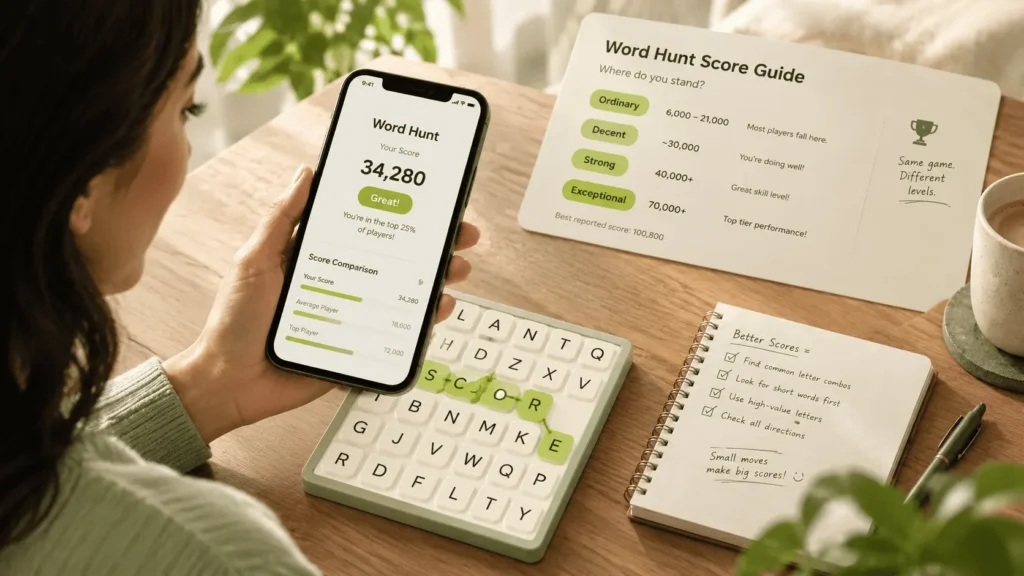
A good Word Hunt score depends on which board you play, and most people have no idea where they stand. It is worth settling that first. Players in the GamePigeon community describe 6,000 to 21,000 as an ordinary range.Around 30,000 is decent, and 40,000 and up is strong. Scores past 70,000 do exist. One player reports a personal best of 100,800, and a record of roughly 90,000 often gets mentioned.
Almost all of the very high scores are on the 5 by 5 board. Our simulation assumed a 90-second round, and it puts the best possible round on a 4 by 4 at about 34,000. On a 5 by 5 it reached 62,000 for an average swiper and closer to 90,000 for a fast one. So if you play the small board and score 15,000, you are doing fine.
The Word Hunt Strategy That Appears Most
The most repeated Word Hunt tip in the community is to look for a consonant, a vowel, a consonant and then an E. Find an -ATE and you can swipe DATE, GATE, HATE, LATE and RATE without reading anything, just by changing the first letter. Few people ever check whether that shape is common enough to be worth hunting. It is, comfortably.
| Pattern | Boards where it appeared | Words per board |
| Consonant, vowel, vowel, consonant | 89% | 6.8 |
| Consonant, vowel, consonant, E | 82% | 5.3 |
| Something plus S | 67% | 19.8 |
| Ends in Y | 41% | 3.3 |
| Ends in ES | 37% | 4.8 |
| Ends in ER | 31% | 2.8 |
| Ends in ED | 23% | 2.4 |
| Ends in ATE | 16% | 0.6 |
| Ends in ING | 2% | 0.1 |
The top shape is the same trick with two vowels in the middle, as in BOOT, BOAT, LEAN, SOAP and ROUT. It turned up on 89% of boards, more than anything else we measured. This also shows why hunting for one ending feels unrewarding. The -ATE ending is on only 16% of boards, while the shape it belongs to is on 82%. Look for the pattern, not the ending.
Which Word Hunt tip wastes your time?
Looking for ING wastes your clock, even though it is one of the most common tips. It showed up on just 2% of boards, at an average of a tenth of one word per board. You could play Word Hunt for a month and see fewer than a dozen of them. Every second spent scanning for ING is a second you are not spending on the two shapes above.
Why the S Is Worth Its Own Pass
The S deserves a pass of its own, because it appeared on 67% of boards and raised what each board was worth. When there was an S, the total points available rose from around 26,400 to around 35,900. Those boards also held an average of 20.7 words ending in S. Most of that is free. On average, 15.7 words per board were just another word on the same board with an S added. That is about 5,900 points for no extra searching.
Swipe CAT, then swipe CATS, and do the same with everything else you found. Community advice agrees and goes a step further: look for S, E, R and D sitting near each other, and add them to whatever you have already played.
Which Letters Make a Good Word Hunt Board?
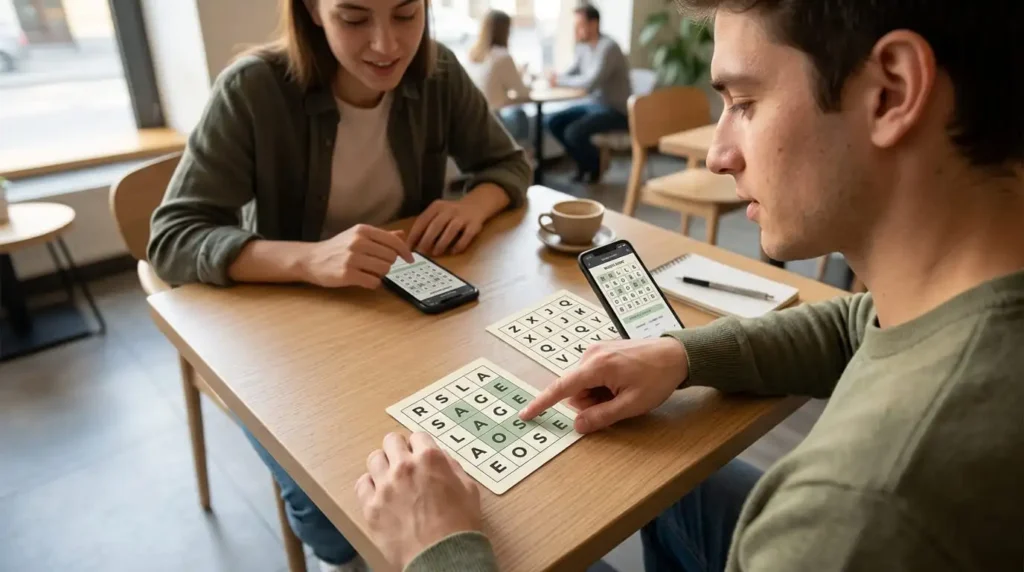
Boards with R, S, L, A, E and O gave the highest average scores. Boards with Z, X, J, Q, V and K gave the lowest. That is no reason to give up on a board. It just helps you tell quickly whether you have a good board. Then you can decide between grinding out three-letter words and hunting for something long.
How Long Are the Longest Words?
Long words are rarer than most people think. The longest word on the board was seven letters on 35% of boards, eight letters on 18% and nine or more on only 5%. So a nine-letter word is not something to aim for, it is luck. The reliable points come from volume, which is why the plural trick and the two shapes above matter more than any single big find.
How to Win at Word Hunt, According to Top Players
Strip away the individual tips and the same four habits come back from every high scorer.
- They never stop moving. Players say again and again to keep swiping no matter what, because a wrong guess costs less than a pause. With so many words on an average board, that is good advice.
- They try words they are not sure about. A guess that fails costs a fraction of a second, but a word you talked yourself out of costs its full score.
- They practise on old boards. You can send a game to your own number and replay it, which is the closest thing to practice the game offers. Replaying a board you have already solved teaches you patterns rather than single words.
- They play people who beat them. Nearly every high scorer mentions this, because you learn new words by watching someone else find them
Word Hunt practice: playing sixes
Stronger players sometimes train with one rule: in this round, only words of six letters or more count. It is a bad way to win but a good way to practice. It pushes you past the short words your eye goes to first. Given how rare long words are, most boards will not give you many, and that is the point.
A Word Hunt Strategy for One Round
- 1.Scan for double vowels and for the consonant, vowel, consonant, E shape, because between them they are on nearly every board.
- 2.Play the short words you spot while you look, since 20 words at 100 points beats one word at 1,800.
- 3.Add an S to everything you have already played.
- 4.Keep moving. If you have time to look at the board and think about it at once, you are not swiping fast enough.
Word Bites, the Other Word Game in the App
Word Bites sits next to Word Hunt in GamePigeon, but it plays nothing like it. Instead of a grid, you get a tray of letter blocks, and some hold one letter while others hold two. Each block is locked to one direction. A horizontal block can only sit in a word that runs
across, and a vertical block in one that runs down.
You drag the blocks onto the board to build words, and one block cannot be part of two words at the same time. That last rule is the one people miss. In Word Hunt one tile can belong to a dozen different words, because you are only tracing a path. Word Bites uses a block up when you place it. Every word you build takes pieces away from the words you have not built yet.
How to play Word Bites and win more often
- Use the awkward blocks first. A two-letter block is much harder to place than a single letter, and pairs are what get left stranded at the end of a round. Build around them early while there is still room.
- Watch the direction, not the letter. A vertical H is not the same as a horizontal H. Say you need a word that runs across, but every consonant you hold is locked vertical. That word cannot happen, however obvious it looks in the tray.
- Pick short words over clever ones. Longer words score more, but a long word eats a lot of blocks and leaves you stuck with what is left. Two four-letter words usually use fewer pieces than one eight-letter word, and both score.
- Save some vowels. Vowel blocks are the ones you run out of, and a tray of consonants with nothing to join them is where a round dies.
Word Bites tips that do not carry over from Word Hunt
Adding an S to everything is the best single habit on a Word Hunt board, worth around 5,900 points a round. It barely helps in Word Bites, because an S block is just one block and you only get the ones you are dealt. Looking for shapes works in both games, but for different reasons. In Word Hunt you look for a pattern that is already in the letters. In Word Bites you choose which pattern to build, so the question is what your blocks can become.
One habit carries straight over, which is never stopping. Both games run against a clock, and hesitating costs more than a wrong attempt does.
Is there a Word Bites solver?
Not on this site yet, because Word Bites needs an engine of its own. Blocks locked to one direction are a different problem from tracing a path across a grid, and far fewer people look for one. If that changes, we will build it properly rather than bolt it on. For the game next to it, our Word Hunt solver takes a board and gives back every word on it, with each swipe path drawn.
Word Hunt Strategy FAQs
What is the fastest way to get better at Word Hunt?
Replay boards you have already solved. You learn shapes rather than single words that way, and shapes carry over to every new board.
Should I learn long words?
Not at first, because nine-letter words are on only 5% of boards. Learning twenty more four-letter words will pay off far more often.
Is the 4 by 4 or the 5 by 5 better for a high score?
The 5 by 5 wins by a wide margin. It holds far more words than anyone can reach in one round. A faster player keeps gaining long after the 4 by 4 has run dry.
Do these numbers come from the real game?
No, they come from two thousand simulated boards built with the published 1987 Boggle dice, because GamePigeon has not released its letter distribution. The proportions should hold, but treat the exact figures as close rather than official.
Where can I see every word on a board?
Put the board into the Word Hunt solver after you play, and it lists everything you could have found. It is the quickest way to see the words you walked past.
One Thing to Try This Week
Play five rounds, and after each one put the board into the solver and look only at the words you missed that end in S. That one group of words is worth about 5,900 points a board and needs no new vocabulary. It is the gap most people can close in a week. Our Boggle solver uses the same board shape if you want more practice away from the clock.
Sources
- Word Hunt round length (80 seconds): wordhunt-solver on GitHub
- Word Hunt points by word length: The Word Finder